September 14, 2025
|9 minutes de lecture

You’ve heard the pitches. “Guaranteed leads.” “Explosive growth.” “A firehose of MQLs.” Every B2B lead generation agency promises to fill your pipeline, and they all come armed with glossy case studies to prove it. But case studies are only part of the story. In today’s competitive landscape, where 50% of marketers consider lead generation their top priority, relying solely on polished success stories can lead to mismatched partnerships that drain resources without delivering results [1]. With economic pressures mounting, every marketing dollar is under scrutiny. Buyers are more discerning, conducting over 70% of their research independently before ever speaking to a sales rep, making the old playbook of simply generating a name and an email address obsolete [8]. The traditional method of vetting an agency is fundamentally flawed, leaving you vulnerable to a partnership that wastes six months of budget on leads that never convert. The numbers paint a stark picture. While 45% of B2B companies reported that generating enough leads was their biggest challenge in 2024, the hard truth is that:
Even when leads are generated, a staggering 80% of them never result in a sale.
This chasm between volume and value is where most agency partnerships fail. The real challenge isn’t just getting leads; it’s getting the right leads at the right time. A successful lead generation partnership isn’t built on promises. It’s built on two foundational documents that are rarely discussed with the rigor they deserve: a contractually-defined Ideal Account Profile (IAP) et un mutuel Service Level Agreement (SLA). Get these right, et vous changez toute la dynamique d’un pari incertain en un moteur de croissance prévisible et responsable. 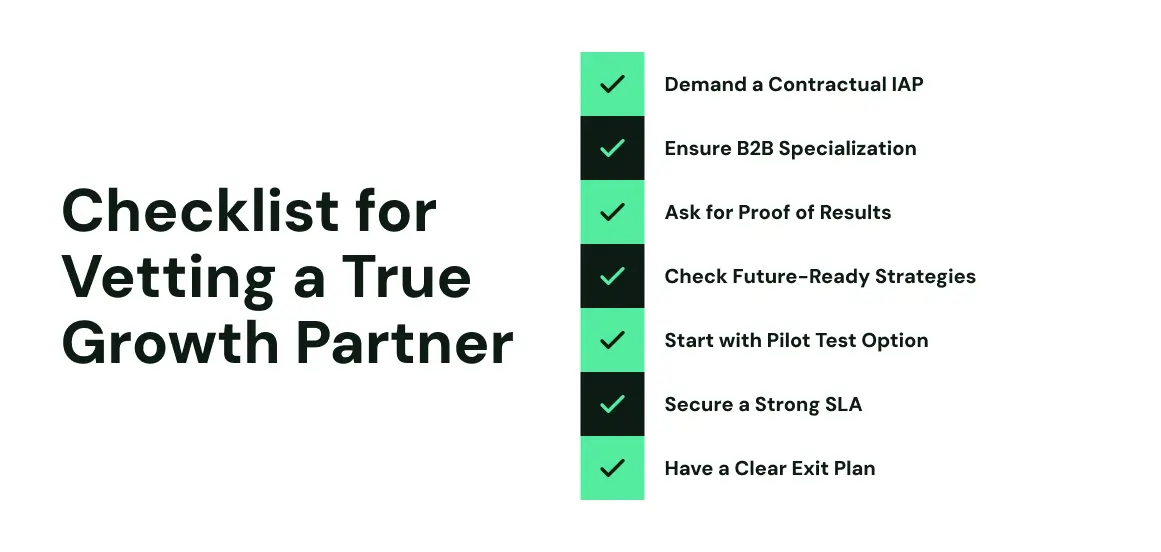
Every agency will claim they understand your target audience. Don’t take their word for it. Un ICP client mal défini est la principale raison des gaspillages de budget marketing et des conflits sans fin sur la qualité des leads. Dans le paysage actuel, un ICP basique n’est plus suffisant. Avec des groupes d’achat B2B qui s’étendent à 6-10 parties prenantes — et plus d’un sur cinq entreprises impliquant six personnes ou plus dans leur DMU — l’accent doit passer des individus à l’ensemble du compte [3]. Cela signifie faire évoluer votre ICP vers un Ideal Account Profile (IAP) en y intégrant des signaux d’intention critiques, comme l’engagement de contenu et le comportement de recherche. Par exemple, une entreprise SaaS ciblant des moyennes entreprises pourrait définir un IAP incluant des signaux tels que des recherches récentes sur les outils de migration vers le cloud ou des décideurs clés interagissant avec des webinaires de concurrents. Cela garantit que les leads ne sont pas seulement démographiquement adaptés, mais aussi activement en marché. Quick Definition Un ICP (Ideal Customer Profile) définit la société idéale (employant l’entreprise) (basé sur des firmographics, technographics, etc.). Buyer Personas décrivent les individus à l’intérieur de cette entreprise (par exemple, “Irene, IT Manager”). Un IAP (Ideal Account Profile) est une évolution de l’ICP qui inclut des signaux d’intention d’achat pour l’ensemble du compte, le traitant comme une entité unique et complexe.
Un IAP véritablement efficace repose sur quatre piliers. Lors de la vérification d’une agence, demandez-leur comment ils construisent et valident chacun d’eux.  Advanced Firmographics Cela va au-delà de la simple taille d’entreprise et du secteur. Un IAP sophistiqué comprend des points de données tels que les dernières levées de fonds, le taux de croissance annuel, et même les tendances d’embauche pour des rôles spécifiques indiquant un besoin pour votre solution. Granular Technographics Savoir qu’une entreprise utilise Salesforce est élément de base. Une excellente agence ira plus loin. Utilisent-ils le produit d’un concurrent ? Leur outil d’automatisation du marketing est-il prêt pour le renouvellement ? Ce niveau de détail permet des messages hyper pertinents. Multi-Layered Intent Signals C’est ici que les meilleures agences se distinguent. Elles doivent démontrer une capacité à synthétiser à la fois l’intention première partie em et l’intention tierce em (par exemple, le même compte recherchant votre catégorie sur G2 ou sur d’autres forums). Cette approche holistique est la meilleure approximation de lire dans l’esprit de votre acheteur. Rigorous Exclusionary Criteria Aussi important que de définir qui vous voulez cibler est de définir qui vous ne voulez pas. Votre IAP contractuel doit inclure des “deal-breakers” explicites — comme des industries spécifiques, des technologies incompatibles ou des régions géographiques — pour empêcher les cycles de vente sur des leads qui ne se convertiront jamais.
An Account-First Approach Ask them to differentiate between a buyer persona, an ICP, and an IAP. Their answer will reveal their strategic depth. Data, Not Assumptions A top-tier agency will insist on a discovery process that uses data from your CRM and potentially AI-driven analytics to build the IAP. This is crucial, as 96% of B2B marketers believe generative AI will significantly impact their content marketing efforts [4]. Contractual Accountability This is the secret most agencies won’t tell you: the IAP should be an appendix to your contract. Any lead delivered that falls outside the contractual IAP can be rejected. This eliminates disputes and forces laser-sharp alignment.
Generic agencies often fail by applying consumer tactics to complex B2B deals. With nearly half of marketing teams facing reduced budgets, specialized agencies that leverage intent data and AI are essential for efficiency [5]. A hidden gem is the dedicated inside sales agency that uses intent data to outperform generalists on lead quality.
Shortlist Via Vetted Sources Use platforms like Clutch.co for unbiased B2B rankings (target agencies with a 4.5+ star rating). Cross-check their LinkedIn presence and industry-specific case studies. Remember, 89% of B2B marketers use LinkedIn for lead generation, so an agency that isn’t practicing what they preach on the platform is a major red flag [6]. Demand Proof of Expertise Don’t just accept a case study. Ask for anonymized examples of campaigns that show clear ROI. For example, since multi-channel campaigns achieve a 31% lower cost-per-lead than single-channel efforts, ask how they integrate channels for efficiency [7]. Evaluate Transparency Insist on seeing their process. Ask for sample copy, targeting lists, and a breakdown of their tech stack. An agency that hides behind a proprietary “black box” of technology without explaining the strategy is waving a red flag.
Pro Tip: An agency that declines a project because they don’t see a clear path to success is signaling integrity.
In a world where 75% of buyers are taking longer to commit to a purchase, you need a long-term partner, not a short-term vendor [8].
The B2B landscape is shifting rapidly. Your potential partner must be at the forefront of these changes.
Top agencies are already integrating cookieless tracking solutions and community-led growth models. Ask them for their strategy on using first-party data as third-party cookies fade. AI adoption is non-negotiable; companies using it properly report up to a 50% increase in lead generation [9].
With 54% of marketers citing improving lead quality as a top challenge, a 1-3 month paid pilot is essential [1]. This allows you to validate an agency’s process, lead quality, and communication before committing to a long-term contract. It’s a low-risk way to ensure they can deliver on their promises.
The SLA is more important than the pricing model. It creates a framework for mutual accountability and defines what success actually looks like.
Many agencies offer a simple “cost-per-lead” (CPL) model. This is often a trap. A CPL model incentivizes the agency to deliver the highest volume of leads for the lowest effort, regardless of quality. This leads to a pipeline full of unqualified names that frustrate your sales team and tarnish marketing’s reputation. A forward-thinking agency will propose a model that aligns with your business outcomes. Look for performance-based retainers with bonuses tied to hitting MQA or Sales Qualified Lead (SQL) targets, or even a pure cost-per-MQA model. This ensures you only pay for accounts that meet the strict, contractually-defined criteria of your IAP.
A Focus on MQAs, Not Just MQLs  The SLA must contain a precise, mutually agreed-upon definition of a Marketing Qualified Account (MQA)—an account that meets your contractual IAP criteria and shows significant buying intent. Data-Backed KPIs Go beyond vague goals. Your SLA should include advanced KPIs like MQA-to-SQL conversion rate (with a target of 30% or higher) and Cost per MQA. Use industry benchmarks, like the average B2B cost per lead of $198.44, to set realistic expectations [11]. Mutual Commitments (The Game-Changer) A true partnership SLA includes client-side commitments. The most important one? A guaranteed timeframe for your sales team to follow up on a qualified lead (e.g., within 24 hours). Strong lead nurturing can generate 50% more sales-ready leads at a 33% lower cost, but it requires both marketing and sales to be in sync [12]. Clear Communication & Reporting Cadence The SLA should define the relationship’s operating rhythm. Will you have weekly check-ins? Who is your dedicated point of contact? How will they report on performance—with a raw data dump or with strategic insights and recommendations? A mismatch in communication styles can doom a partnership just as quickly as poor performance.
Choosing an agency is just the beginning. The best partnerships are built on a foundation of continuous communication and data-driven iteration. Onboard Collaboratively: Set up joint dashboards for real-time visibility into the metrics defined in your SLA. Monitor and Iterate: Hold weekly or bi-weekly meetings to review performance. If a channel isn’t working, be prepared to pivot. Use insights from the data to refine the IAP and campaign tactics. Have an Exit Plan: If metrics consistently falter and the agency is unable to course-correct, your contract should have clear exit terms. Annual reassessments prevent stagnation and ensure the partnership remains a strategic asset.
When vetting, steer clear of agencies over-relying on outdated tactics like mass emails, which yield low engagement in 2025. Avoid those without proven ABM experience, as B2B success increasingly hinges on account-focused strategies. Finally, don’t overlook pricing transparency; hidden fees can balloon costs, eroding ROI in a budget-conscious year. Choosing a lead generation partner is one of the most critical marketing decisions you’ll make. By moving beyond surface-level evaluations and demanding a partnership built on a contractual IAP and a mutual SLA, you can secure a growth engine that delivers quality, predictability, and a genuine return on your investment. Partner with a strategist to build a growth engine. The difference begins with the IAP and is guaranteed by the SLA.



Recevez par e-mail de nouveaux rapports et analyses de KKBC.
 CH


 CH